Showing posts with label Religion. Show all posts

Wednesday, November 13, 2013

Monsignor Francis J. Ansbro: a Full Life, and a Full Heart

By Patrick J. Walsh

My friend Francis has died.

After 87 years on this Earth, 47 of which he spent in service to the Roman Catholic community of Peekskill, New York at the Church of Our Lady of the Assumption, Monsignor Francis J. Ansbro has entered into eternal life.

Along with the large number of those whose lives he impacted as a priest, I mourn his loss, and marvel at the results of his ministry.

It is heartening to realize that even in this time when the average person doesn't hear a whole lot of praise for the priestly life, there are those whose example makes it easy to see and celebrate the virtues of the humble Catholic clergyman.


Monsignor Ansbro saying Mass for my parents' 25th wedding anniversary, June, 1973.

But even as I ponder his achievements — so evident in the tender recollections of his fellow priests, and the fervent admiration of the parishioners he served — I cannot help but think of him, simply, as my friend Francis.

In my recollections, he is still the bright, innocent-looking young man who seemed more like an older brother or youthful uncle when I was a child; the wise, gentle friend chatting with my Dad and Mom across the dinner table when I was a young man; and finally, my dear old friend in those increasingly rare moments when we ran into each other in later years, as he struggled with ill health and I dealt with the usual preoccupations of approaching middle age.

Other than my beloved aunt, who is a Dominican Sister, Monsignor Ansbro was the formative inspiration of my understanding of the religious as warm and welcoming individuals with full lives and full hearts.

His humility and kindness were evident in every interaction I ever had with him, over the entire course of the time I knew him.

Although his understanding of life was far advanced from my own, and by virtue of his profession, education and experience he was far superior in wisdom and understanding, he approached me always, simply, as a friend.

When I was a child, he delighted in chatting about baseball or talking about my favorite foods, or making silly puns. In the midst of a conversation with my Mom and Dad and I, he would nonchalantly refer to himself as "Ancis Fansbro" — and then slyly sneak a look at each of us to see how long it would take for us to realize what he'd said.

In my mid-20s, when my Dad was preparing for his own rapidly approaching death, at an age that still seems far too young for all those who knew and loved him, Father Ansbro shared the experience with us as deeply as any family member.

Looking back in recent days, I've come to realize that he and my Dad had been friends for some 22 years at the time of Dad's passing — fully a third of my father's entire life. And I remember vividly the gentle priest's words of admiration for the way in which Dad dealt with his final illness, when he said he'd never seen anyone approach death with such faith.

As an adult, I'd like to think that I was always on my best behavior whenever I was in the presence of my friend Francis. He did after all inspire the best instincts in me; and yet his casual good humor and gentle manner never failed to put me at ease, and I always felt free to express my thoughts with him as I would with any other close friend.

For all the familiarity that he engendered, however, he was still first and foremost a dedicated servant of God. I consider it a great blessing that I was able to personally witness his extraordinary devotion to the church, even in trying or difficult circumstances.

In that light I recall the time we spent together in the early 1980s, when Father Ansbro accompanied Dad and Mom and I on a vacation to my parents' summer cottage in Maine. I remember how he delighted in saying Mass each day, sharing the Eucharist with us at a makeshift altar in the modest cottage in the remote Maine woods.

He faithfully brought us to the Lord's table each day during our sojourn together, despite having badly cut his foot while swimming in the lake on the first day of the trip.

We shared the blessings of faith and family and friendship, then and throughout the years, and I feel blessed to have grown up with such a positive role model for my Catholic faith, and with such a good and kind friend.

In this time of mourning our loss and celebrating the gift of his life, I pray for him, and for all those he loved.

© Patrick J. Walsh


Wednesday, April 3, 2013

At the Side of the Road

By Patrick J. Walsh

Today, as I trekked along my daily path in the park near my home, these days of Easter week brought to mind one of my favorite stories from the Bible: the description of the risen Christ walking with the disciples on the road to Emmaus (Luke 24; 13-35).


The park often inspires me to reflect on sacred things, as its beauty transcends the effects of the heavy use it endures due to its location in a densely populated suburban area.

In the brief struggles of its smallest living creatures, as well as the vast slow turning of sky and wind and time that shapes even the largest of its sturdy trees and stone slopes, the park does, after all, know the particulars of life and death.

As I walked today, I thought of how Cleopas and the other disciple in the biblical account were joined on their journey by the stranger who they initially failed to recognize.

Making their way forward in his company, they burst forth with vivid accounts of the events that have led up to the Crucifixion, and they ponder the details of the first reports of the Resurrection. All the while, they have no idea that they are talking to the central figure of the events they are describing.

In the midst of my reflections, I stepped to the side of the paved road as a big red SUV rumbled by, revealing in its rush a mere glimpse of the bike pinioned to its rear door. A few minutes later, it rolled back down the road in the opposite direction, leading me to again step aside.

Walking the ancient road with their unknown companion, the disciples displayed an uncanny exuberance while recounting the events at the heart of their disappointment and sorrow.

I sometimes imagine the vague outline of a smile on the Holy countenance, as Jesus listened patiently to the worries of his companions before explaining to them how his life and death fit into the pattern of religious prophecy and the promise of human history.


In the park in these days of Easter twenty one centuries later, we speed past those gifts that serve as expressions of a larger wisdom, as we pass every treasure of wizened tree or turbid pond or clouded sky, lost in the frustrations and sadness of our own modern journey.

And sometimes as I walk, I wonder at all we might be missing when we fail to recognize the nature of all that accompanies us, as we make our way along the road each day.

© Patrick J. Walsh

Wednesday, March 13, 2013

A Walk in the Park: Today


By Patrick J. Walsh

Today I walked in the park.

It has been nearly two and a half months since my Mom passed away, and today was the first day since her passing that I have been able to walk in the park.

Although I was by myself, I did not feel alone. It seemed as though I might be walking a bit slower than I have in the past, but that may have been an artifact of the emotions involved, or simply the result of my lingering reacquaintance with the pleasantness of my surroundings.

  
As I walked, my mind was awash in the notion of what it would be like to live a life of pure spirit. Unencumbered by the infirmities of age or illness or the limitations of this physical existence, the life of the spirit could be open to the experience of all good things, immediately, without reservation.

Following a physical life of faith and joy and the preparation born of the sharing of one’s experiences and treasure without hesitation, the life of the spirit seems a logical extension of a will well exercised in gratitude and service.

In recent days, the exhilaration of this line of thought has helped to temper the sadness of my grieving, and given rise to the kind of hope that sustains mourner and mystic alike.

In this time of Lenten temperance, it is a hope whose comfort is familiar to me, having been a part of all the Easters of my childhood, and a defining characteristic of my Holy Week preparations as an adult.


I walked in the park today. I was by myself, but I did not feel alone.

It is nice to know that we can walk together again, free of the limitations of age and infirmity and illness.

My steps are a little slower than they once were, my progress a little less than it will one day be. But it is good to walk again, and to not be alone.

© Patrick J. Walsh


Friday, December 21, 2012

Anticipation


“The bare branches of the trees cause me 
to think of the straw of the stable…”

By Patrick J. Walsh

There are scant few days left before Christmas, and even fewer before the winter solstice. Time is short for the short days of darkness, and it feels good to anticipate the goodness and light that will arrive with the progress of nature and the promise of the spirit.

My walks in recent days have been littered with “little worries” — items on my “to do” list that are not yet done, for example; or last minute preparations that I have stubbornly refused to let wait until last minute, as though worrying would get them done sooner.

Today there is a fresh, light wind stirring the reedy limbs of some sparse evergreens near the edge of the road. The thin branches wave slightly, as if in greeting, as I walk by.

© Patrick J. Walsh
"...the reedy limbs of some sparse evergreens 
wave slightly, as if in greeting, as I walk by."

In the traditions of my religious faith, this time of year evokes images of a stable, and animals kept for domestic purposes by the keeper of an inn.

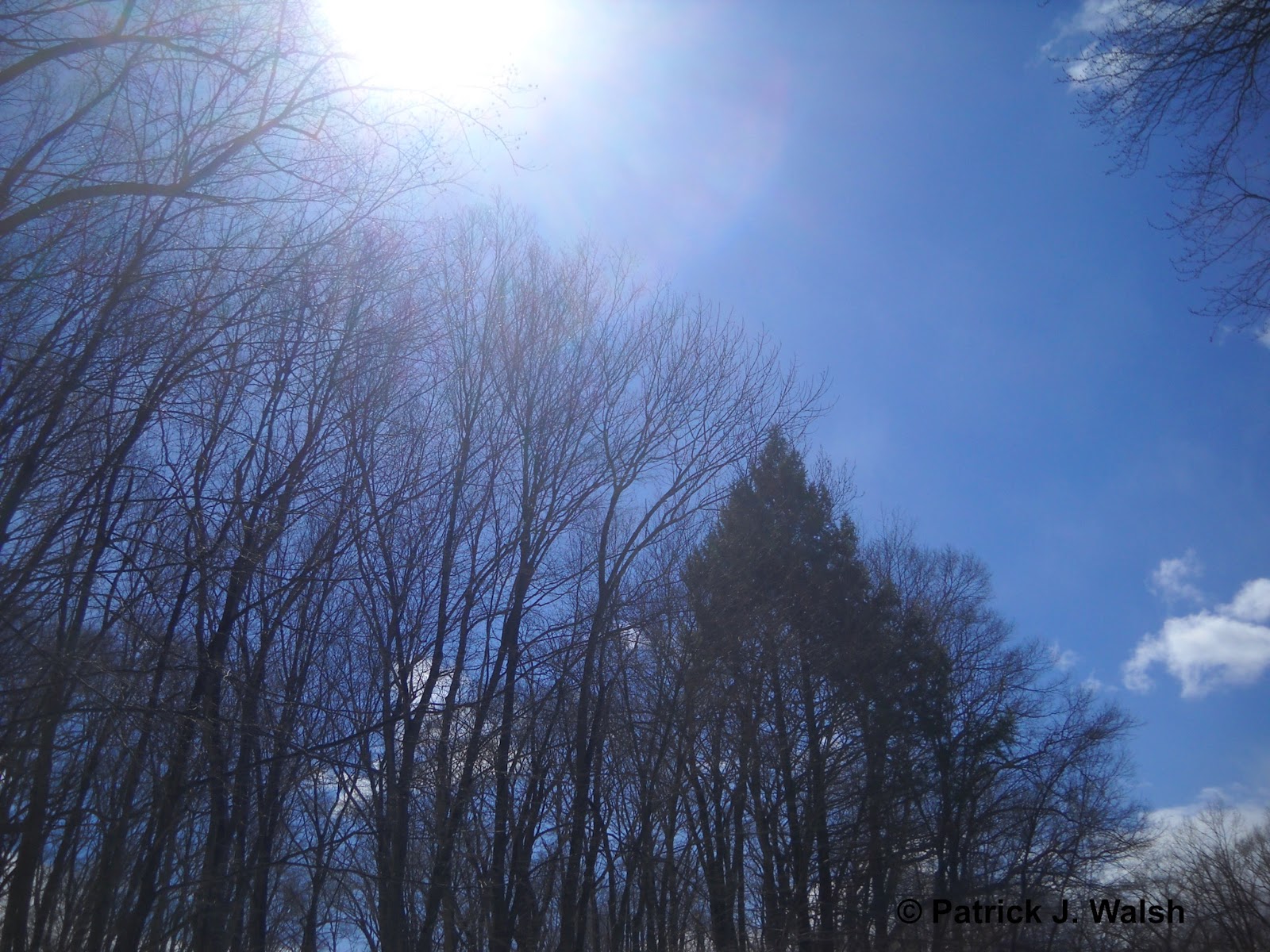
Cross-hatched gray across the darkening blue of the sky, the bare branches of the trees that surround the evergreens cause me to think of the straw of the stable, shuffled into rough shapes of nests by the beasts in whatever time they might have had free from their burden.

Not yet touched by the presence of the family that would transform it into a signal site of transformation in the course of human history, the stable was probably typical of the modest accommodation necessary to the upkeep of animals, then and now. And by all accounts of zoology and history, the inhabitants of the stable were likely similar in most details to their modern descendents.

As I walk along the edge of the woodline, I think of the similarities and differences between the animals of the stable and the creatures that inhabit the woods around the park.

They are of course different types of animals; although there are horse paths in the park, the large majority of its inhabitants are common wildlife — squirrels, deer, ducks and geese — that has little in common with any version, ancient or modern, of horse or donkey or oxen.

And yet they are all progeny of the development of nature, and they each play a productive role in the ecology of their time and place.

For those who wish to infer a spirituality in the pattern and direction of their progress, there is a winsome link of familiarity between the meek denizens of the Biblical stable and whatever creatures might be encountered in the modern nexus of metropolis and nature.

Thinking of the straw and the donkey, and the sparse evergreen and the deer, the distance in millennia and the far span of the earth from that time and place to this very spot becomes somehow less distant.

So remote from the straw and the smell and the noise of those long ago animals, yet blessed with the benefits of belief and tradition and history, I move through the park as though on pilgrimage, thinking of the family and the birth and the child that were, at this time so long ago, still on their way toward the stable…

© Patrick J. Walsh


Friday, October 26, 2012

The Halloween Tree


“The hidden colors of the trees await the dawn of the new day, and another chance for revelation…”

By Patrick J. Walsh

With the arrival of Autumn here in the Northeast, there are a lot of trees sporting vibrant colors, as their leaves are transformed from the greens of Spring and summer to the varied hues of Fall.

In the park where I walk, there are colors everywhere: bright red and yellow and orange, mixed here and there with the darker shades of purple and brown, and still a fair amount of stubborn straggling green. The leaves mirror the bounty of the harvest season, and the coming celebrations of Halloween and Thanksgiving.

On these pleasant Autumn days, it is easy to imagine nature donning her colors as a sort of mask, dressing up like a child anticipating the delight of the Halloween ritual of trick or treat.

© Patrick J. Walsh
Each day the tree unveils a bit more color, as though
it were taking part in some silent conversation…

The ‘trick’, of course, is that the process by which the leaves change from green to their various colors is actually the opposite of ‘putting on’ color; it is instead a process of revelation, as the pigments already in the leaves are revealed when the green pigment of chlorophyll fades away.

During the longer days of Spring and summer, chlorophyll plays an important role in photosynthesis — the process by which the leaves transform water and carbon dioxide into the glucose that provides energy for the trees, as well as the oxygen that serves as a useful byproduct for the rest of the environment.

In the Fall, when days grow shorter and trees prepare to weather the winter months by living off their stored food, the process of photosynthesis slows and the reduced role of chlorophyll results in the fading of the green and the emergence of the hidden colors.

Among all the brightly colored trees in the park, there is one in particular that each day unveils a bit more color, as though it were taking part in some silent conversation while it gradually changes from a vibrant green to an incredibly vivid orange.

In this time of reflection alternating with anticipation, I have come to think of the tree with the bright green and orange leaves as a Halloween Tree. In its slow transformation, it seems to costume itself as a symbol of the movement of the days of this particular year, from the gentle warmth of summer to the nervous chill of Autumn.

This natural transformation of the seasons is mirrored in the historic and cultural markings of the holiday. In its 18th century origin, “Halloween” was derived as a contraction of “All Hallow Even (as in ‘evening’),” — a reminder that the fanciful celebration of costumes and apparitions is in fact a harbinger of the Christian religious celebration of All Saints Day.

In memory and in application, as its practice passes from one generation to the next, Halloween in these suburbs around the park reveals much about what is important to the people who live here.

For children, there is the innocent joy of being out after dark with family and friends, and the excitement of visiting the neighbors to share the creativity of a Halloween costume while receiving gifts of candy and a warm welcome. For adults, there is the casual interaction of the social ritual, and consideration of the larger implications inherent in the Christian rite of the following day.

And in the muted voices of the celebration moving up and down the street and in the coolness of the Autumn evening, there is the slow transformation of the seasons, while the hidden colors of the trees await the dawn of the new day, and another chance for revelation in the brief time left before winter.

© Patrick J. Walsh

The Walk in the Park series:
• The Hawk

Saturday, September 8, 2012

A Walk in the Park: The Men


"...they gather careful and quiet around the open grill, 
meticulously ensuring that no flame goes unminded..."

By Patrick J. Walsh

Many families happily occupy the park during the seasons of warm weather and bright light. On weekends there are small groups gathered at picnic tables, the elder and middle aged members of the family engaged in conversation, the younger adults trailing along after the littlest ones, who prefer to play on the swings or the slide, or to toss a ball, or to simply run around.

Sometimes there are volleyball nets and loosely formed teams playing for fun; and on occasion there are goals delineated by plastic trash cans or bright orange traffic cones, and small groups of friends kicking a soccer ball.

In the late Spring and throughout the long days of summer, it is not uncommon to see a decorative tablecloth fixed to the surface of one of the wooden tables with the string end of a group of lighter-than-air balloons, together proclaiming the celebration of a birthday or similar milestone event.

photo © Patrick J. Walsh
They populate silent prayers in the chill wind...
Family Gatherings

And all around these human manifestations of family life, there are other gatherings. At about the same time each year that the first cake and presents appear in the picnic area, the first goslings totter out onto the open grass near the pond. Bedecked in the grayish yellow down that softens the first few months of their existence, the tiny geese present a comic living tableau of life in the bird world. Their dark beaks seemingly too big for their tiny heads, their webbed feet seeming only loosely attached at the end of their spindly legs, they follow along as the adult members of the family excavate the edge of the pond for food, or move into the water itself.

In the woods nearby, meanwhile, there are hollows in the earth where rabbits raise their young. The tiny ones just begun on their journey into the world, not yet grown into their cartoonish oversized ears, depend on the keen curious explorations of their parents to provide sustenance and to protect them from danger.

There are families everywhere in the park: the fox with her kits, the gray flash of squirrels scurrying across the leaves in the woods; the spawn of fish and frogs in and around the water, the inexhaustible supply of buzzing, humming, droning insects in all corners. And above, in the branches, nests are alive with the heedless haranguing of twittering baby birds, hungry to be fed.

Throughout the seasons, the family life of the park is augmented by a carnivalesque array of other individuals and groups. There are small gatherings of youngsters hanging out at the edge of the parking lot, couples strolling hand-in-hand along the road, cyclists of astounding athleticism making their way through the trails in the woods, and the occasional hiker dreamily walking along from one area to the next, seeming lost in his thoughts.

The Men

And there are the men. There are not many of them; they gather in small numbers, often huddled together as though to make themselves as inconspicuous as possible. In summer they are nearly invisible, collecting in the remotest parts of the park. They are there early, and late. Sometimes there is some marker of their day’s work, in a shopping cart half-filled with cans destined for redemption for the small amount of change they will bring. Sometimes there is the smoky aroma of fish frying on one of the open grills that are a fixture throughout the wide picnic area.

The men are there, even when they are not physically in the park. They populate silent prayers in the chill wind of wintry afternoons, giving rise to thoughts of the admonition of Moses (in the Old Testament Book of Deuteronomy) about how ‘the poor will be always with you’:

“For the poor shall never cease out of the land: therefore I command thee, saying, Thou shalt open thine hand wide unto thy brother, to thy poor, and to thy needy, in thy land.”

Silently, from afar, the men haunt the mirror images of the families who gather for the brief happy celebrations of summer. In the first warm days of Spring, they return, thinner, grayer, even more ill-defined in character and form, having been faded by the worst days and nights of winter.

And as the Fall approaches, they gather careful and quiet around the open grill, meticulously ensuring that no flame goes unminded amid the treasure of richly colored Autumn leaves, brittle and dry, that are spread randomly across the hardened ground.

© Patrick J. Walsh

The Walk in the Park series: