Showing posts with label NASA. Show all posts

Saturday, August 25, 2012

Images of Neil Armstrong, 1930-2012

By Patrick J. Walsh

As I reflect on the life and death of Neil Armstrong, I realize that my most compelling perceptions of him as an American hero have as much to do with how he lived in the 30-plus years before and the 43 years after he became the first human being to walk on the Moon as they do with that iconic moment itself.

The image of a young boy in love with the idea of flight, open to all the possibilities and challenges of a uniquely American future in an era when life was not easy here or around the world — that is how I imagine the young Neil Armstrong.

My vision is informed by reading and research, touched by fascination with the individual and the times as they are presented in historical documents, and imbued with the personal knowledge of others who shared that phase of life at that particular time in history.

Then there is the image of a man so in love with the idea of service and community and the quiet dignity of the American ideal of helping others, however and wherever we might find ourselves.

Approaching middle age as an anointed hero of epic proportion, he was presented suddenly with unprecedented opportunities of celebrity and wealth and public adulation. Given his status as a sort of super civil servant, he chose the ideal over the advantage, electing to pursue a quiet, dignified life as an instructor of others who might well further those ideals in the course of future generations.
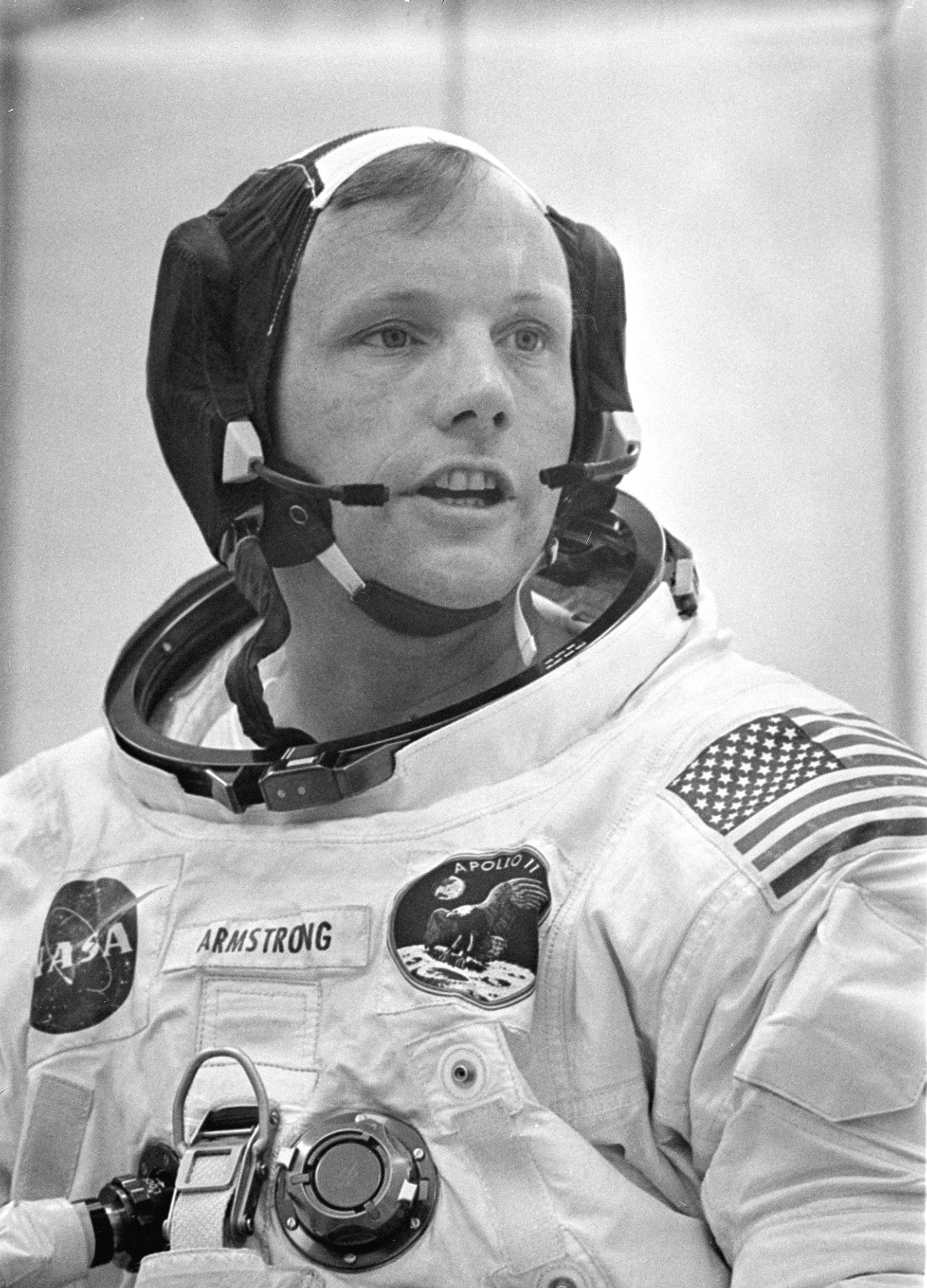
Neil Armstrong during preparations for Apollo 11 in 1969.
NASA photo.
Through knowledge, through inference, by study and by intuition, in knowing of his deeds and hearing and seeing him speak on those rare occasions when this modest, decent man felt it appropriate to do so, I have felt privileged to embrace Neil Armstrong as a personal hero — an individual concerned with bettering the lives of others through dedication, service and the pursuit and sharing of knowledge and wisdom.

As his remarkable life now passes in its entirety into history, I hope he will be known and celebrated for all these reasons, as well as for those moments in that halcyon summer of 1969 when he landed on and walked on the surface of the Moon.

I will think of him when I look up into the night sky, knowing the significance of what he did there, and I will remember him for the ideas and ideals that marked his life before and after that extraordinary evening, while he lived out his life in the service of others here on Earth.

© Patrick J. Walsh

Check out these episodes of Pat’s video series “Five Minutes in Space” that celebrate important moments from the amazing life and career of Neil Armstrong:

(http://youtu.be/p5I5Bd0J5ts)

(http://youtu.be/weQEPXK6yyI)

(http://youtu.be/ICpT58HMsgc)


Tuesday, July 24, 2012

Statement on the Passing of Dr. Sally Ride


FOR IMMEDIATE RELEASE - statement on the passing of Dr. Sally Ride:

"I was sad to hear the news of Dr. Ride's passing. My thoughts and prayers are with her family and friends. I don't know if folks today are aware of just how difficult it was for women to pursue careers in the service and particularly in aerospace and engineering, or just how remarkable it was for a woman to pursue a career as an astronaut, at the time that Dr. Ride did. She was a brave and courageous person, on Earth as well as in the heavens."

— Patrick Walsh, author, Spaceflight: A Historical Encyclopedia and Echoes Among the Stars, and creator of the documentary video series Five Minutes in Space (episode #6, "Sally Ride: Making Real The Promise," available at  http://youtu.be/k2cFtcDBC3o ).


Transcript, "Sally Ride: Making Real The Promise"
Five Minutes in Space Episode #6 (06/01/11) - Sally Ride: Making Real The Promise

by Patrick J. Walsh

In a lifetime of achievement, it is only the individual who can single out one moment as being more meaningful than any other...

But in a lifetime devoted to others, every person touched by one individual’s achievement can pinpoint any one of many moments that define the essence of what it means to be a hero...

On June 18, 1983, Sally Ride became the first female American astronaut to fly in space.

Her flight made real the promise of space exploration for every future generation of American women, and was the first of a series of remarkable achievements by female astronauts.

More than two decades after the first American was launched into space, nearly fourteen years after American astronauts first landed on the Moon, two years after the first space shuttle launch, America’s first female astronaut to fly in space lifted off as a mission specialist during the STS-7 flight of the space shuttle Challenger.

Robert Crippen commanded Challenger for the historic flight; Frederick Hauck piloted the shuttle; and the crew also included mission specialists John Fabian and Norman Thagard.

The crew deployed two communications satellites, and made the first deployment of the Shuttle Pallet Satellite, a platform outfitted with television and film cameras that provided stunning views of the space shuttle in orbit.

The mission went smoothly from start to finish, and the crew safely returned to Earth at Edwards Air Force Base in California, after a flight of slightly more than six days.

As outstanding an achievement as it was for her to be chosen as America’s first female astronaut to fly in space, even a cursory glance at Sally Ride’s pre-flight resume would make it obvious that she indeed had the “right stuff” to join the astronaut corps.

Prior to her selection in January, 1978 as a member of NASA’s eighth group of astronaut candidates, Ride had pursued a remarkable academic career at Stanford University, where she would earn a doctorate in physics after completing two bachelor’s degrees and a master’s degree.

She would again fly in space during the STS-41G mission in October, 1984 -- a flight whose highlights included Kathryn Sullivan making the first-ever spacewalk by an American woman.

Ride was also scheduled to make a third space flight, but that mission was canceled in the wake of the January, 1986 accident that resulted in the loss of the space shuttle Challenger and its crew.

But while the suspension of flights following the accident would ultimately end her career as an active space explorer, it also marked the beginning of a new call to service, when she was appointed by President Ronald Reagan as a member of the commission that would investigate the Challenger accident.

In the years following the tragedy, Ride founded NASA’s Office of Exploration, and authored the influential report, “Leadership and America’s Future in Space,” which helped to shape the space agency’s long range strategic planning.

She left NASA in 1987, and subsequently became a professor of physics at the University of California, bringing a uniquely inspiring perspective to the task of educating future generations of scientists and engineers.

She has since continued to serve as an inspiration to others as president of Sally Ride Science, which creates educational materials for young students across the U.S., and she is also the author of several space-themed books for children -- many of whom, no doubt, will one day point to that moment in which they first became truly immersed in their studies, and trace its inspiration to the first American woman to fly in space.

--- 30 ---


Saturday, June 30, 2012

Apollo 10: The Last Long Light of A Different Day

By Patrick J. Walsh

In the Spring of 1969, America had a new President. After narrowly defeating Vice President Hubert Humphrey, Richard Nixon was settling into the first few months of his first term in the Oval Office.

At the time, the number of U.S. troops engaged in the Vietnam War was 540,000 — the highest level it would reach during the entire course of the conflict.

And as the last vestige of winter withered away in the Northeastern United States and the tentative warmth of spring made its first appearance, I was only just beginning to become aware of the activities of the National Aeronautics and Space Administration, which at that time was making its final preparations to send the crew of Apollo 10 a quarter million miles into space, to the very edge of the Moon.

Reflecting on those days now, I find it striking that in the course of a lifetime, and in the long pull of history, there are moments that are freighted with the indelible importance of personal experience.

There are those tragic moments -- such as the assassination of President Kennedy, or the Apollo1 fire, to name two examples from the context of the space program -- that remain etched on the granite stone of shared memories with a certain stoic emptiness of grief.

And there are those times of elation — as when Neil Armstrong and Buzz Aldrin made the first landing on the Moon — that are so widely shared and deeply held as to become touchstones of the collective experience.

The journey to that moment — the moment when the Eagle lunar module settled onto the surface of the Moon in July, 1969 — reached its penultimate milestone with Apollo 10.

Designed as an ‘end-to-end’ test of everything necessary to a lunar landing, except for the landing itself, Apollo 10 launched May 18, 1969. The flight was commanded by Tom Stafford, whose crew consisted of command module pilot John Young and lunar module pilot Eugene Cernan.

In the course of testing the procedures, vehicles, systems and equipment necessary to the later landing missions, the Apollo 10 crew became just the second group of human beings to orbit the Moon (the crew of Apollo 8 had been first, in December, 1968).

Then, when they separated the Apollo 10 lunar module from the combined command and service modules, Stafford and Cernan became the first astronauts to operate an Apollo lunar module in lunar orbit.


Apollo 10 lunar module pilot Eugene Cernan. NASA photo.
In a nod to the Apollo program's place in popular culture, the Apollo 10 lunar module
was dubbed "Snoopy," in honor of the beloved character from the Charles Schulz
comic strip Peanuts. The command module was given the call sign “Charlie Brown.”
In their tiny spacecraft some 47,000 feet above the lunar surface, Stafford and Cernan were just a shadow away from landing on the Moon.

But that moment would wait. Apollo 10 was, ultimately, designed to be overshadowed by other missions that would mark the history books with the manifestations of a new era.

In that later day, John Young would return to the lunar neighborhood and would land, and walk on the surface, as commander of Apollo 16 in April, 1972.

Eugene Cernan would land on the Moon as commander of Apollo 17 in December, 1972. He would explore amid the lunar dust and in a moment of particular poignancy, he would be the last of the Apollo lunar explorers to leave the surface, as the first phase of lunar exploration came to a close.

And Tom Stafford would, in July, 1975, preside over the final flight of the Apollo program, as commander of the American portion of the unique cooperative spaceflight of the Cold War era, the Apollo-Soyuz Test Project.

But in that Spring of 1969, even as the prospect of those future milestones that would define the Apollo program drew closer, all those moments were still somewhere farther down the road.

And at that moment, as my little part of the world felt the promise of those first warm days of Spring, the crew of Apollo 10 was busy preparing the way to the Moon, dutifully ensuring all that was necessary for all that was yet to come...

© 2012 Patrick J. Walsh

From the video series Five Minutes in Space
Learn more about these important steps on the way to the Moon:

• Apollo 10: Within A Shadow of the Moon

• Apollo 1: The First Team

• Freedom 7: Fifteen Minutes That Changed the World


Saturday, February 18, 2012

Recalling the flight of Friendship 7: John Glenn would triumph...


by Patrick J. Walsh

When John Glenn rode his Friendship 7 Mercury space capsule into orbit on February 20, 1962, he elevated the U.S. space effort onto an even par with the manned space program of the country’s superpower rival, the Soviet Union. His flight was celebrated for the achievement it represented for the astronaut and for the space agency that had made it possible, and as a victory for the United States in the nation’s Cold War competition with the Soviets.

With the benefit of hindsight on the fiftieth anniversary of the event, it is easy to celebrate the significance of Glenn’s Friendship 7 odyssey while missing the intensity of the drama that accompanied it. There was, for example, the urgency expressed by the American media and felt by the American public that pressured NASA to achieve an orbital mission after two sub-orbital Mercury flights, during a period when the Soviets had already achieved two piloted trips in orbit. Similarly, there was an implication -- often made explicit by the Soviet political leadership -- that falling behind in the ‘space race’ was the same as falling behind in military capability and technical prowess, as well as lagging in the competition for the ‘hearts and minds’ of other nations.

Thus the courage and capability displayed by America’s first astronauts accounted for far more than the successful achievement of the goals of a particular mission. The flights required a heroism far-sighted enough to understand the larger importance of one’s own actions, as well as the concentration necessary to focus on every detail necessary to the success of each objective along the way.

John Glenn enters the Friendship 7 Mercury spacecraft prior to his landmark flight as
the first American to orbit the Earth.
Photo courtesy of NASA (www.nasaimages.org).
In the particular case of John Glenn, the decency and patriotism at the heart of his upbringing and his personality were ample resources for his success as an astronaut, and his military training and piloting skills equipped him well for flying the other-worldly Mercury “space capsule.” Further supported by the nation’s foremost engineering minds at NASA, he could reasonably expect his landmark flight aboard Friendship 7 to proceed as planned...

And yet an unexpected drama still cropped up during the flight, when an instrument reading from the spacecraft -- then in the midst of its second orbit -- indicated that the lifesaving heat shield at the bottom of the capsule, which was vital to protecting the astronaut and the vehicle during the reentry stage of the flight -- had somehow come loose.

The unexpected tension -- and ultimate triumphant -- of John Glenn’s landmark spaceflight on February 20, 1962 is covered in detail in “Five Minutes in Space -- Friendship 7: A Flicker in Orbit.”

It was perhaps a fitting metaphor that the drama that elevated NASA’s carefully planned first orbital flight into a worrisome ordeal would ultimately prove as passing as the faulty instrument reading that gave rise to it in the first place. Memories of that wintry day would still, some five decades later, be adorned with images of the handsome, smiling space pilot, celebrated by his grateful fellow citizens with presidential acclaim and a joyful parade in the nation’s signature city.

John Glenn would triumph, as the courageous astronaut in Friendship 7; the dedicated senator from Ohio for a quarter century; and again as the oldest individual to fly in space, when he flew aboard the STS-95 flight of the space shuttle Discovery in 1998.

© 2012 Patrick J. Walsh

Monday, January 30, 2012

Five Minutes in Space: One Year Online


The Apollo 1 crew (l to r): Gus Grissom, Ed White, Roger Chaffee
photo courtesy of NASA • www.nasaimages.org


The new episode of my video series "Five Minutes in Space," which I've just posted today, marks the start of the series' second year.

This installment, "Apollo 1: The First Team," recalls the tragic loss of the first Apollo crew, who perished when a fire broke out in their spacecraft during a test on January 27, 1967. Rather than dwell on the grim details of the accident, I've focused on the lives and legacy of crew members Gus Grissom, Ed White, and Roger Chaffee, and their dedication to the ideals of service to others and exploration of the unknown.


This episode also features snippets of two of my musical compositions: the FMS theme, "Stomp It," which appears at the start and end of every episode; and for the first time, a few brief clips from "Landing at Noctis Labyrinthus," which I've only previously used once, in an ad for my book Spaceflight: A Historical Encyclopedia.

Five Minutes in Space #13 - Apollo 1: The First Team
is available now at: